To study mineral composition of ores, special thin section or polished thin section specimens that are made of pieces of rocks and ores are used. Polarizing microscopes of transmitted light are used for petrographic researches. Microscopes of reflected light are used to study ores. The petrographic microscope allows studying only optical properties of minerals and excludes contact with the studied object, and mineragraphic microscopes allow both studying optical properties and impacting minerals in different ways. Three-dimensional microscopes are widely used, especially for studying large samples.
Definition of ore minerals is the first and most important research phase of ores. Definition of the minerals composing an ore is necessary at all stages of fields research. Complex geological and mineralogical researches are also systematically conducted in the course of exploration of the field; at the same time, mineralogical mapping and testing have to accompany geological mapping and prospecting testing at all stages of prospecting works.
At the search stage of works, the geologist needs to know a full complex of the minerals which are present in rocks of the site being explored, to find out which of them can be mineral resources. The issue of possibility of minerals extraction from the rocks is being resolved. At this stage of works, the primary role is played by the chemical analysis, but it cannot replace mineralogical researches. Mineragraphy allows defining not only minerals, but also the smallest inclusions in minerals and studying regularities of their distribution. Only knowing the number of inclusions of impurities in a mineral, it is possible to define precisely its structure and to calculate a formula. The mineragraphic method is important also for studying paragenetic mineral associations, structures and textures of ores, on the basis of which the concept of the proper understanding of processes for ore formation is developed. All in all, together with geological and petrographic researches, these data allow establishing genetic type of the field and thereby evaluating it properly and selecting the most effective method of exploration and development.
The institute is planning to maintain the common reference and analytical database in English and Russian in relation to the fundamental and applied scientific researches that are carried out by the Institute, as well as around the world, including: research of ore indication, research of washability, study of thermodynamic properties of natural compounds, technologies of gas and coal fields development. Use of the reference and analytical database, which actually means open access to specialized expert information of the international level, will be provided to higher educational technical institutions from different countries of the world. Access to the database will be open for the Kazakhstani educational institutions free of charge. It will enable activation of research activities of the faculties at the higher educational institutions of the country and widespread introduction of research methods in educational processes. In order to establish cooperation with foreign colleagues, reference and analytical database will have an option of maintaining profiles of research associates that will create a possibility of using it as the systems of citing.
The Institute for the Issues of the Subsoil Complex Development together with KazNIMI has developed "Temporary Instructions for Calculation and Application of the Anchorage in the Mines of Karaganda Basin" which has been agreed with the Regional State Inspectorate for Prevention and Elimination of Emergency Situations and the State Technical Supervision, as well as has been approved by the Technical Director of the Coal Department at Mittal Steel Temirtau JSC.
Selection of rational ways of driving, fastening and maintaining mine openings and their trimming is defined by stability of rocks. VNIMI classification for suspension method has been taken as the basis by stability.
On the basis of the analysis of the features of wallrocks in Karaganda Basin, its physical-mechanical properties, structures, 4 classes of excavations roof rocks by stability can be identified, in which anchorage is applicable:
- stable;
- average stability;
- unstable;
- very unstable.
Parameters for anchorage are:
- design resistance;
- pliability;
- distance between anchors among and between rows;
- density of anchors installation.
When applying anchorage in combination with the frame pliable timbering or with the means for its strengthening in the zone of temporary bearing pressure, parameters also include constructive vertical pliability of the frame timbering, timbering resistance, density of its installation.
Calculation of parameters for anchorage, as well as combined timbering and means for strengthening in the zone of temporary bearing pressure is made given the sizes and depths of the mine opening location, method and parameters of its protection, durability, jointing and stability of wall rocks and intensity of ground pressure manifestations.
Calculation and selection of parameter for mine openings fastening is made based on the sites, for which change of the above factors makes more than 15%.
Gravitational Concentration Methods
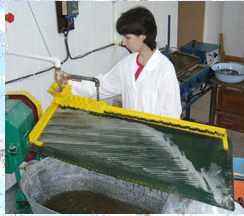
Concentrating Table SKO-0.5
It is intended for division of minerals in the water environment based on their density in concentration of ores of non-ferrous, rare and precious metals.
Main characteristics:
- productivity is 50 kg/h;
- specific electric power consumption 4 kWh;
- fineness of supply 3+0.04 mm;
- extraction of minerals up to 95%.
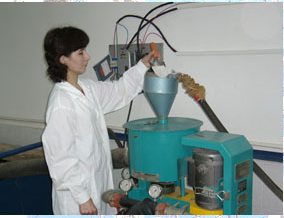
Knelson Concentrator 7.5
It is intended for concentrating precious metals from radical ores and scatterings
Main characteristics:
- supply 680 kg/h;
- the same in the crushed ore 95 l/m;
- density of the crushed ore 0-75%;
- fineness of supply 4.7 mm;
- extraction up to 95%.
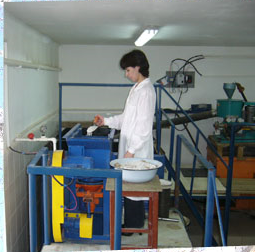
Diaphragm-Type Jigging Machine MOD-0.2
It is intended for concentration of ores of ferrous, non-ferrous, rare and noble metals. It is used in case of barite testing as the laboratory equipment.
Characteristics:
- number of cameras 2;
- fineness of supply - no more than 8 mm;
- maximum productivity 0.5 m3/h;
- power consumption is 0.37 kW;
- maximum extraction of gold from the material not aligned by the size 20-25%.
MAGNETIC CONCENTRATION METHODS
Magnetic methods are broadly used for concentration of ores of non-ferrous metals, in case of finishing concentrates of rare and non-ferrous metals, for regeneration of strongly magnetic weighting compounds in case of dense medium concentration, for removing iron impurities from phosphorene ores, quartz sands and other materials.
In case of magnetic concentration, only heterogeneous magnetic fields are used. Such fields are created by the appropriate form and layout of poles of magnetic system of the separator. Magnetic systems are separated to open and closed ones.
Magnetic separation is the method of mineral processing based on difference in magnetic properties of the separated components, in heterogeneous constant or variable environment. Magnetic separation is the main method for iron and manganese ores concentration. Magnetic separation allows making high-grade concentrates with the content of iron up to 68%, manganese up to 43%, extraction of magnetic products in the concentrate exceeds 90%.
Magnetic separation is used also for ores of non-ferrous and rare metals, mining-chemical and non-metallic raw materials, as well as for honing operations after gravitational concentration, as well as for removing metal and ferriferous impurities from materials (kaolin clays, lean moulding sands, etc.).
The essence of the method is the impact on particles of ore by magnetic and mechanical forces, as a result of which particles with different magnetic properties acquire different paths of movement.
This allows magnetic particles of the initial ore concentrating in a separate magnetic product (most often a concentrate), and non-magnetic – in non-magnetic fraction (waste).
DRY AND WET SIEVE ANALYSIS OF ORE AND NON-ORE MATERIALS IN THE RANGE OF 0.045-10 MM
Methods of Magnetic Separation
- Dry Magnetic Separation
Coarsely disseminated magnetite and other strongly magnetic ores with fineness of up to 100 mm are subject to dry magnetic separation for the purpose of their pre-concentration or receiving a ready concentrate, as well as other materials (fluxes, slags, etc.) and ores (for example, low-magnetic iron, aluminum, etc.) for the purpose of removal of strongly magnetic minerals from them.
The condition for obtaining good technological indices of concentration of strongly magnetic ores is application of their preliminary classification, which is pulling most together the top and lower limits of fineness of the minerals being separated. For example, in concentration of magnetite ores with fineness of -50 +0 or -25 +0 mm, their preliminary separation based on classes +6(8) and-6 (8) of mm considerably improves results of magnetic concentration.
Fine ore is usually subject to dust removal before dry magnetic concentration. The efficiency of this operation depends on the force of mutual coupling of particles, which is growing along with the humidity increase and reduction of material fineness. Therefore, permissible moisture content, for example, for dense magnetite ore with fineness of -3 +0 mm is 0.5 — 1%, for ore of -6 +0 mm — 1 — 1.5%, for ore of -12 +0 mm — 2 — 2.5%.
- Wet Magnetic Separation
Thin impregnated ores and other materials after their crushing to necessary extent of disclosure of the extracted minerals are exposed to wet magnetic separation.
Drum-type separators with weak magnetic field, lower supply, direct-flow, counter-flow and semi-counter-flow baths have gained the most popularity as the main devices for concentration of fine-grain ores.
Analysette-3 Vibratory Sieve Shaker
"Analysette 3" is vertically oscillatory laboratory sieve shaker for exact separation and sorting of materials according to the sizes of particles.
The granulometric analysis can be carried out both for dry powders and for the particles weighed in liquid. Depending on the volume of a sample and its particle size, various sets of sieves are selected. Up to 10 analytical sieves and a decanter of 50 mm height each per one sieving (or 16 sieves and a decanter of 25 mm height) are used.
Various functions of sieving management are possible:
- amplitude control;
- amplitude display;
- sieving with intervals.
The combination with AUTOSIEVE program provides analysis according to DIN ISO 9000.
SMRS 12/14-R Roller-Type Magnetic Separator
It is intended for dry magnetic separation of low-magnetic materials with fineness from 0.1 to 2 mm:
- productivity is 1 t/h;
- magnetic induction on the surface of a magnetic roller in case of 20о С is 1 100 mT;
- quantity of turns of the feed roller (regulated) – 35 RPM;
- quantity of turns of the magnetic roller (regulated) – 93 RPM.
SBM 2-40/20-N Drum-Type Magnetic Separator
It is intended for wet magnetic separation of strongly magnetic materials with fineness from 0 to 3 mm:
- productivity is 5-100 kg/h;
- maximum magnetic induction on a drum surface in 20о С - 280 mT;
- the rotating speed of the shell, regulated – 10-60 RPM;
- contents of solid in the supply – no more than 25-35%
The granulometric analysis of monomineral fractions is usually carried out by means of sieve or sedimentation analysis.
Currently, this problem is successfully solved with the help of Fritz (Germany) automatic laser granulometer.
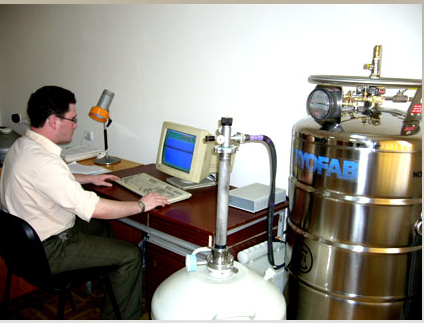
The unit is intended for measurement of specific heat capacity of solid and liquid substances by the method of adiabatic calorimetry.
Main specifications and characteristics:
- temperature range of measurements 4-350 K
- limit of permissible value of relative deviation of measurement in the temperature ranges:
* 4-40 K – 2%;
* 40-350 K – 0.5%;
- sample volume: 1 cubic cm;
- working environment:
* bath of liquid helium (4-80 K);
* bath of liquid nitrogen (80-350 K).
Certificate of "KazInMetr" RSE No. 632 dated 03.05.2005 has been conferred upon the unit.
IKON LLP has been included in the structure of the Public Service of Standard Help Data (PSSHD) as the specialized organization.
Calculations of structural properties of compounds in a solid state on the basis of their crystal structure are carried out. To make calculations, semi-empirical methods of quantum and chemical calculation (AM/1, MNDO, PM3, PM5) as a part of MOPAC software package and methods of crystal lattice dynamics in LADY program (Lattice Dynamics Toolkit v.2.09) are used. Description of structural characteristics of substances is provided on the basis of models of interatomic potentials or a valent force field. Based on these data, oscillatory, phonon and thermodynamic properties of compounds in a wide interval of temperatures are calculated. If necessary, calculation and specification of atomic positions of hydrogen atoms in an elementary cell of compound is made. The final results at calculations are data on the provision of strips of absorption in a range of combinational dispersion and an infrared range of connections, schedule of density of phonon states and the main thermodynamic functions: heat capacity, enthalpy and entropy.
The technology and method of long-wavelength exploration allow carrying out mapping and sounding of oil fields, gas, water, ore, coal and metals. Long-wavelength exploration is a nondestructive method and all researches are carried out on a surface without drilling operations.
The technology and method of long-wavelength exploration are based on direct determination of availability of certain substances such as oil and gas, water, coal, ores and minerals. In terms of the measurement approach, this method is referred to the methods in the field of electromagnetic resonance.
The special transferring and receiving antennas have been developed for excitation of a signal and its registration. Last represents the sensor detector which is controlled by the operator. 12V battery is the power supply source that provides portability and high flexibility of the method. All operations are carried out on the surface. There is no need for drilling of exploratory wells. Depth of sounding can reach 5 000 m. The number of retrieval group depending on complexity of the task is 3-5 people which is much less than in case of use of other methods. To cover a bigger territory and to increase speed of the measurements related to it, equipment can be set in the vehicle. At the same time measurements are taken with motion speed on terrain of up to 20 – 30 km/h.